
How to Buy Property in Dubai as a Foreign Investor: Complete Guide 2026
Dubai has become one of the world’s most accessible property markets for international investors. Since the Freehold Law of 2002, foreign nationals have been allowed to own property outright in designated zones — with no local partner, no income tax, and no age restrictions. Heading into 2026, the process to buy property in Dubai as a foreign investor is more streamlined than ever, backed by digital platforms like Dubai REST, regulated escrow protection for off-plan purchases, and new mortgage rules that favor non-resident buyers. Whether you are a first-time Foreign Investor or expanding your global portfolio, understanding the legal framework and practical steps is essential for a successful Dubai property acquisition.
This guide covers everything you need: eligibility, freehold zones, the step-by-step buying process, total costs, mortgage options, residency benefits, and the mistakes to avoid.

Can Foreigners Buy Property in Dubai?
Yes. Foreign nationals of any nationality can purchase property in Dubai’s designated freehold zones with full ownership rights. There is no requirement to hold a UAE residency visa, no age limit, and no cap on the number of properties you can own.
The legal foundation is Regulation No. 3 of 2006, which identifies the specific zones where foreign ownership is permitted. The Dubai Land Department (DLD) oversees all property registration and title deed issuance, while the Real Estate Regulatory Agency (RERA) regulates developers, brokers, and transactions.
The only restriction is geographic: foreign buyers can only purchase in designated freehold zones. Areas like Deira and Al Karama remain reserved for UAE and GCC nationals.
Understanding Property Ownership Types in Dubai
Before signing anything, you need to understand how ownership works. Three structures exist:
Freehold ownership grants full ownership of both the property and the land it sits on. The title deed is registered in your name at the DLD. You can sell, lease, mortgage, or gift the property freely. For most foreign investors, freehold is the standard — and the only structure that provides full legal protection and resale flexibility.
Leasehold ownership grants the right to use a property for up to 99 years without owning the underlying land. Leasehold arrangements are less common in modern developments and typically apply to older communities outside designated freehold zones.
Usufruct rights provide long-term use and benefit rights without full ownership. This structure is uncommon for international buyers and usually appears in specific master-planned developments.
Freehold is the right choice for virtually every foreign investor. It carries the strongest legal protections, full DLD registration, and unrestricted resale rights.

Designated Freehold Zones for Foreign Buyers
As of 2026, Dubai has over 60 designated freehold areas, with new zones added periodically by decree. The most actively traded zones include:
- Downtown Dubai — Premium district anchored by Burj Khalifa and Dubai Mall. High prices, strong short-term rental demand.
- Dubai Marina — Waterfront high-rise community. Rental yields typically range from 6% to 8% for apartments.
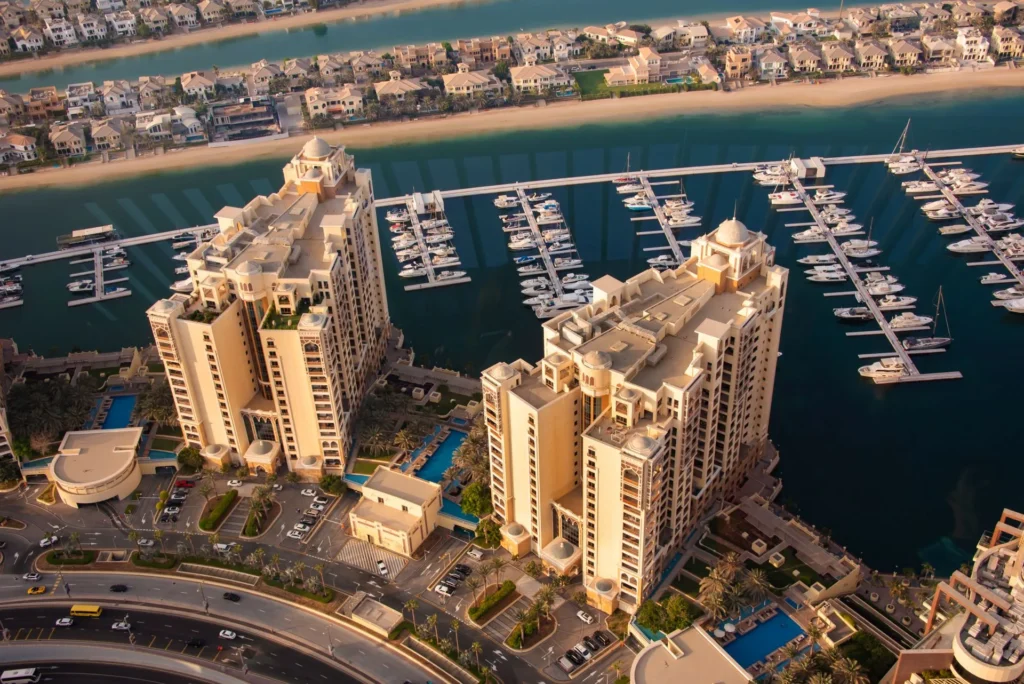
- Palm Jumeirah — Iconic island with luxury villas and apartments. Higher entry prices, strong capital appreciation record.
- Business Bay — Commercial and residential hub adjacent to Downtown. Accessible price points for reaching the AED 2M Golden Visa threshold.
- Jumeirah Village Circle (JVC) — Mid-market community with newer developments. Competitive pricing and rental yields commonly between 6% and 8%.
- Dubai Hills Estate — Emaar master-planned community with villas, apartments, golf course, and retail.
- Arabian Ranches — Established villa community with strong school infrastructure. Family-oriented demand.
- Jumeirah Beach Residence (JBR) — Beachfront apartments with heavy tourist footfall and short-term rental potential.
- Dubai Creek Harbour — Emerging waterfront district by Emaar with long-term growth potential.
- Mohammed Bin Rashid City (MBR City) — Large mixed-use development with villas and townhouses.
The full official list is available on the DLD website (dubailand.gov.ae). Always verify that your target property is in a designated freehold area before making any commitment.
Step-by-Step Process to Buy Property in Dubai
The process is structured and transparent. Here is what to expect:
Step 1 — Define your budget and objectives
Determine your total investment capacity, including the property price plus 7–10% for closing costs. Clarify whether your priority is rental income, capital appreciation, personal use, or residency eligibility.
Gayrimenkul fiyatına kapanış masrafları için %7-10 ekleyerek toplam yatırım kapasitenizi belirleyin. Önceliğinizin kira geliri, sermaye değer artışı, kişisel kullanım veya ikamet izni uygunluğu olup olmadığını netleştirin.
Step 2 — Engage a RERA-licensed broker
Work only with brokers registered through RERA’s Trakheesi system. Licensed brokers provide market access, legal guidance, and transaction coordination. Verify credentials before signing any agreement.
Step 3 — Select a property
Choose between ready (completed) properties on the secondary market or off-plan (under construction) units from developers. Each path has distinct cost structures and risk profiles, covered in detail below.
Step 4 — Sign the Memorandum of Understanding (Form F)
Once terms are agreed, both parties sign Form F — the standardized MOU regulated by RERA. A 10% deposit is paid at this stage, typically held by the broker in escrow. Form F outlines the sale price, payment schedule, and transfer timeline.
Step 5 — Obtain a No Objection Certificate (NOC)
The seller requests an NOC from the developer confirming that all service charges and fees on the property are settled. NOC fees range from AED 500 to AED 5,000 depending on the developer.
Step 6 — Transfer ownership at the DLD
Both parties attend a DLD-approved trustee office. The buyer pays the DLD transfer fee (4% of purchase price), trustee fees, and title deed issuance costs. The DLD then issues a new title deed in the buyer’s name.
Step 7 — Register utilities and tenancy
After receiving the title deed, register for DEWA (Dubai Electricity and Water Authority) services. If renting the property out, register the tenancy contract through Ejari, Dubai’s mandatory rental registration system.
Estimated timeline: 2 to 4 weeks for a cash purchase of a ready property. Mortgage-backed purchases typically take 4 to 6 weeks due to bank processing.
Total Costs: What You Will Actually Pay
The purchase price is only part of the total investment. Budget 7–10% above the property price for transaction costs. Here is the full breakdown:
| Fee | Amount | Notes |
|---|---|---|
| DLD transfer fee | 4% of purchase price | Largest single cost; officially split 2% buyer / 2% seller, but market practice is buyer pays full 4% |
| Trustee office fee | AED 4,200 (incl. VAT) | For properties above AED 500,000 |
| Title deed issuance | AED 580 | Standard administrative charge |
| Developer NOC | AED 500–5,000 | Varies by developer |
| Agency commission | 2% + 5% VAT | Paid by buyer for resale; often developer-covered for off-plan |
| Mortgage registration (if applicable) | 0.25% of loan amount + AED 290 | Only for financed purchases |
| Property valuation (if applicable) | AED 2,500–3,500 | Required by bank for mortgage approval |
Example — AED 2,000,000 apartment (cash purchase): DLD transfer fee AED 80,000 + Trustee fee AED 4,200 + Title deed AED 580 + NOC ~AED 2,000 + Agency commission AED 42,000 (2% + VAT) = approximately AED 128,780 in transaction costs. Total true investment: ~AED 2,128,780 ($580,000 USD).
Important 2026 update: Transaction fees can no longer be added to mortgage financing. DLD fees, agency commissions, and admin costs must all be paid in cash upfront.
Mortgage Options for Foreign Buyers
Non-resident foreign nationals can obtain mortgages from UAE banks, though terms differ from those offered to residents.
Key terms for non-resident buyers:
- Loan-to-value (LTV) ratio: Up to 50–60% for non-residents on properties under AED 5 million. UAE residents can access up to 80% LTV.
- Down payment: 35–40% minimum for non-residents on the first property. On an AED 2,000,000 apartment, expect to pay at least AED 700,000–800,000 upfront, plus closing costs.
- Interest rates: Variable rates typically start around 4.2% annually for expatriates, with rate and tenure varying by bank and borrower profile.
- Loan tenure: Up to 25 years, not extending beyond age 65 (employed borrowers) or 70 (self-employed).
- Pre-approval timeline: 5 to 10 working days, depending on the bank and documentation.
Banks commonly offering mortgages to non-residents include Emirates NBD, Abu Dhabi Commercial Bank (ADCB), Mashreq Bank, Dubai Islamic Bank, and HSBC UAE. Compare at least three offers before committing — rate and fee structures differ significantly.
Mortgage process:
- Obtain Approval in Principle (AIP) from the chosen bank.
- Select a property and sign the MOU (Form F).
- Bank orders an independent property valuation.
- Final mortgage approval and loan offer issuance.
- Mortgage registration at the DLD (0.25% of loan amount + AED 290).
- Ownership transfer and title deed issuance.
Off-Plan vs. Ready Properties
This decision shapes both your upfront costs and your risk exposure.
Ready (completed) properties: Title deed issued immediately upon transfer. Rental income begins from day one. No construction risk — what you see is what you get. Closing costs higher (7–10%) due to agency commission and immediate mortgage registration. Best for income-focused investors who want certainty.
Off-plan (under construction) properties: Purchased directly from developers, usually with structured payment plans (20/80, 40/60, or post-handover plans). Lower upfront costs — agency commission is typically developer-covered, and closing costs run 4–6% versus 7–10% for ready properties. All payments are held in RERA-regulated escrow accounts, protecting buyers from developer misuse. Off-plan contracts are registered through the DLD’s Oqood system, which provides legal ownership protection during construction. Main risk: construction delays. Always verify the developer’s RERA registration and delivery track record before committing.
Residency Visas Through Dubai Property
Property ownership can unlock UAE residency. Two main pathways exist:
| Feature | 2-Year Investor Visa | 10-Year Golden Visa |
|---|---|---|
| Minimum property value | AED 750,000 (~$204,000) | AED 2,000,000 (~$545,000) |
| Property status | Must be completed and habitable | Ready or off-plan (approved developers) |
| Mortgage eligibility | 50% paid, bank NOC required | Mortgage accepted regardless of balance (as of Feb 2026) |
| Minimum stay | Entry every 180 days | No minimum stay requirement |
| Family sponsorship | Spouse and children | Spouse, children, and parents |
| Multiple properties | Allowed if combined value meets threshold | Allowed if combined value meets threshold |
For a full breakdown of the Golden Visa pathway, see our dedicated guide: Dubai Golden Visa Through Real Estate: How to Qualify in 2026.
Tax Implications for Foreign Investors
Dubai’s tax environment is one of the primary reasons international investors choose this market over London, New York, or Singapore.
No personal income tax. Rental income and capital gains from property sales are not taxed in the UAE. For investors from high-tax jurisdictions, net returns can be substantially higher than comparable markets.
No annual property tax. Unlike the UK’s council tax or US property tax, Dubai does not levy a recurring annual property tax. However, a “housing fee” of 5% of the annual rental value is charged monthly through DEWA utility bills.
No inheritance tax. The UAE does not impose inheritance tax on property. However, succession rules may apply based on the owner’s nationality or religion. Non-Muslim foreign owners can register a will with the DIFC Courts or Dubai Notary Public to ensure assets are distributed according to their wishes rather than UAE personal status law.
One-time transfer fee. The 4% DLD transfer fee at purchase is effectively the primary government revenue from property transactions.
Foreign investors may still be liable for income or capital gains tax in their country of residence. Consult a tax advisor familiar with your home jurisdiction and any double taxation agreements with the UAE.
Common Mistakes Foreign Buyers Make
Based on patterns reported by brokers, legal advisors, and regulatory bodies, these are the errors to avoid:
Not verifying freehold status. Always confirm the property is in a designated freehold area before signing. Use the DLD website or Dubai REST app.
Underestimating total costs. Budgeting only for the purchase price is the single most common mistake. Always add 7–10% for transaction costs on ready properties.
Skipping developer due diligence. For off-plan purchases, verify the developer’s RERA registration, escrow compliance, and project delivery history. Avoid developers without a proven track record.
Paying deposits before verification. Never pay any deposit before confirming the seller is the registered owner through the DLD title deed verification tool and that the property is free of legal encumbrances.
Working with unlicensed agents. Always verify broker credentials through RERA’s Trakheesi system. Unlicensed brokers offer no legal protection if disputes arise.
Ignoring service charges. Every Dubai property carries annual service charges (typically AED 10–30 per square foot, depending on the community). Verify these before purchase — they directly impact net rental yield.
Overlooking currency risk. The AED is pegged to the USD, which benefits dollar-denominated investors but introduces exposure for those earning in EUR, GBP, TRY, or other currencies.
Common Questions From Foreign Investors
Do I need to be in Dubai to buy property? No. Many foreign investors complete the purchase remotely through a Power of Attorney (POA) issued to a lawyer or trusted representative. The POA must be notarized, apostilled, and translated into Arabic.
Can I buy property through a company? Yes. Properties can be held through UAE-registered companies, offshore entities, or foreign corporations. Standard DLD fees apply. Corporate ownership can offer inheritance and asset protection benefits but adds administrative complexity.
How long does it take to get a title deed? For ready properties, the title deed is issued on the day of transfer at the DLD. For off-plan purchases, you receive an Oqood certificate during construction, which converts to a standard title deed at handover.
Can I rent out my property immediately? Yes. Once the title deed is issued and DEWA services are active, you can list the property for long-term or short-term rental. Short-term rentals require an additional DTCM (Department of Tourism and Commerce Marketing) permit.
What happens if I want to sell? There is no minimum holding period. You can sell at any time, though off-plan units may have developer-imposed restrictions until a certain payment milestone is reached. Capital gains are not taxed in the UAE.
Is Buying Property in Dubai Right for You?
For the right investor Dubai real estate offers a combination of advantages that few global markets can match.
The case for Dubai: Rental yields of 5–9% depending on area and property type — substantially higher than most Western cities. Zero personal income tax, zero capital gains tax, and no annual property tax. A stable currency pegged to the USD. Clear legal framework for foreign ownership backed by the DLD. Direct pathway to residency through property investment, including the 10-year Golden Visa.
Worth considering: Dubai’s property market is cyclical. Prices in premium zones have risen sharply since 2021, and some analysts note certain segments may approach correction territory. Service charges can meaningfully reduce net yields. Currency exposure matters for non-USD investors. The market rewards long-term holding — short-term speculation is riskier.
Who benefits most: The Dubai market suits investors with a medium-to-long-term horizon, those seeking tax-efficient income, individuals targeting residency alongside returns, and those who can deploy at least AED 750,000 (the 2-year investor visa threshold) or AED 2,000,000 (the Golden Visa threshold).
NYC Consultancy advises foreign investors across Turkey, Azerbaijan, the Middle East, and South Asia on Dubai property acquisition — from area selection and due diligence through to residency application support. If you are evaluating this market, professional guidance helps avoid costly mistakes and align your investment with clear financial and lifestyle goals.
The Path Forward
Buying property in Dubai as a foreign investor in 2026 is legally straightforward, financially attractive, and operationally efficient. The key steps are clear: identify a property in a designated freehold zone, engage a RERA-licensed broker, sign Form F, transfer ownership at the DLD, and register utilities. Budget 7–10% above the purchase price, understand whether ready or off-plan fits your objectives, and verify every developer and broker credential before committing funds.
If you are ready to explore Dubai’s property market with clear, investor-focused guidance, book a free consultation with our Dubai property advisors at NYC Consultancy. We help investors make informed decisions at every stage — from neighborhood selection to final title deed registration.